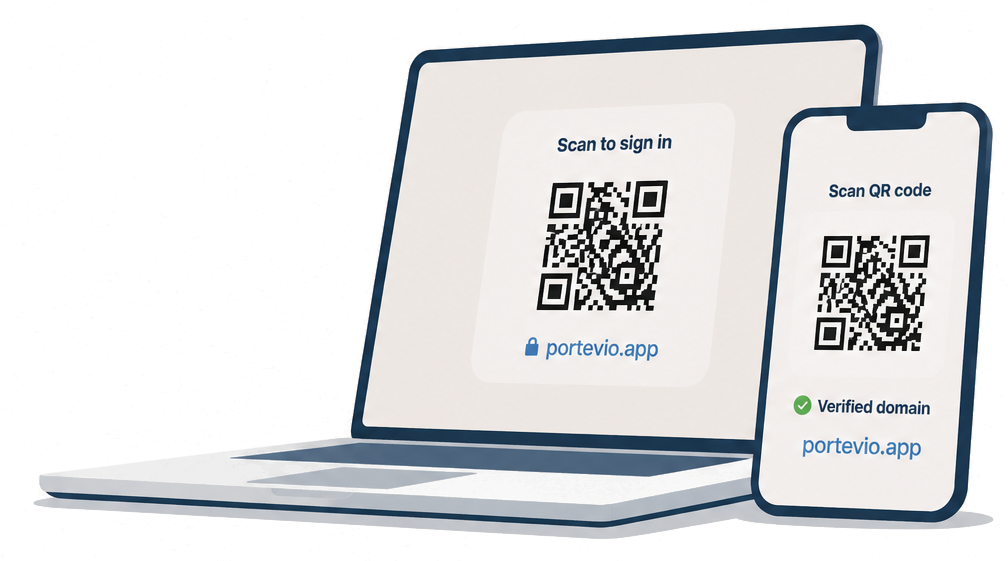
Phishing-resistant credential sharing for small teams. Secrets stay on trusted devices — not on servers.
Device-bound
Secrets stay on your devices
QR-powered
Share access with a scan
Verifiably shared
Access is always verified
The tools haven't kept up. The threats have.
Passwords live in spreadsheets, browser autofill, and forgotten docs.
A fake login page is often enough. Traditional tools still trust the browser.
Nobody knows who shared access, when it happened, or where it went.
SMEs are expected to prove cyber hygiene and access control.
The trust model lives on the devices your team already carries.
Detects the login page and creates encrypted session context.
Phone scans QR and verifies the real domain locally.
Credentials are decrypted only on-device.
Phone signs a one-time authentication response.
No clipboard. No typing. No credential exposure.
Portevio only relays encrypted packets between trusted devices. It cannot read, recover, or store credentials.
A short walkthrough of the QR-powered login and device-bound workflow.
Scan to authenticate with local domain verification.
Secrets are encrypted and stored only on trusted devices.
End-to-end encrypted credential transfers between devices.
Cryptographic log of who shared what, with whom, and when.
Organize credentials by team, project, role, or client.
Export access history for compliance reviews and internal audits.
Portevio is designed around one simple rule: credentials should never become server data.
| Capability | Traditional | Portevio |
|---|---|---|
| Server-side vault | Yes | No |
| QR domain verification | No | Yes |
| Device-only decryption | Limited | Yes |
| Cryptographic sharing logs | Limited | Yes |
| SME-first workflows | Weak | Built-in |
Portevio is currently under active development and nearing a testable release. Looking to connect with partners, early adopters, and endorsers who care about practical security for small teams.
Request Early Access